
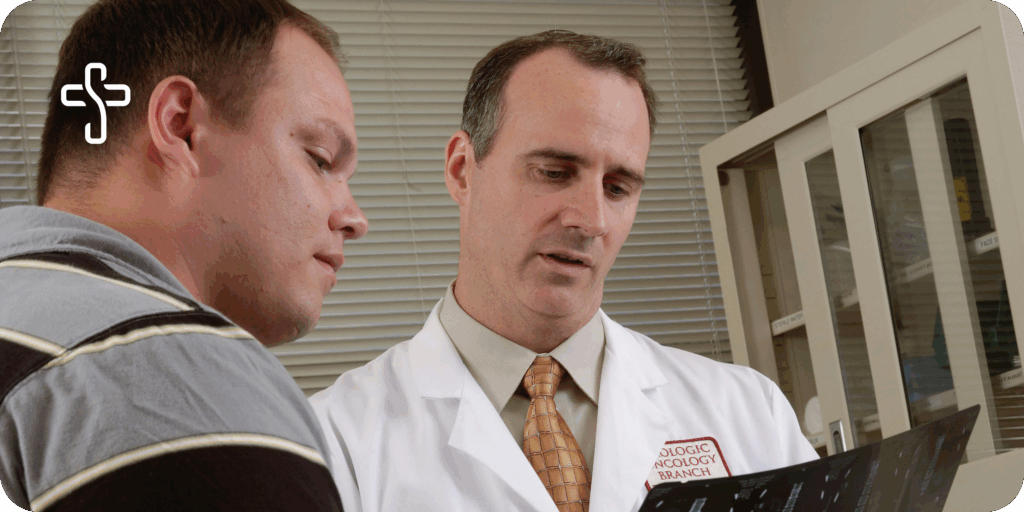
Solidarity HealthShare’s Chief Medical Officer Dr. John Oertle joins The BS Show to talk about precision medicine and the importance of advocating for your own care. Read the transcript or listen to the interview below.
Bob Sansevere (00:00):
We are joined by Dr. John Oertle, the co-founder and Chief Medical Officer for Solidarity Healthshare at solidarityhealthshare.org. Doctor, I got to tell you, you wrote something for Solidarity, the headline: “At the forefront of Healthcare Precision Medicine.” We’re going to ask about that, but Catholic churches, I mean, you were giving us some background on how involved the Catholic Church has been in medicine over the years, and this one impressed me. Gregor Johan, Mendel, a Catholic Augustinian monk and priest considered the father of modern genetics. That’s impressive.
Dr. John Oertle (00:40):
Yeah, I appreciate that. I think what people don’t really maybe understand in today’s day and age is that the Catholic church has been fighting for education and science, and so it’s one of these, we oftentimes hear that the Catholic church has somehow anti-science, and actually that’s not true. The Catholic church has been a promoter of science across the centuries of even through the Middle Ages. And so Gregor Mendel is a great example of this being a Catholic monk who is the one that actually studied how genetics work with plants. And so he’s the father of genetics, and this is what we use even today with the technology to be able to advance the quality of life and length of life for individuals and better, more effective treatment with personalizing our medical treatments based around the individual, not upon this one size fits all.
Bob Sansevere (01:37):
You did write about precision medicine, and I mean that’s something that also obviously the Catholic hospitals are involved in, but explain for people that don’t know what it is, and would there be precision medicine without AI and without, I mean obviously you need advanced, you mentioned advanced diagnostic tools, but is AI a big, big part of precision medicine? Because I’m fascinated with what AI is doing and will continue to do.
Dr. John Oertle (02:06):
Yeah, so it’s been a wonderful advent to improve and move forward the development of precision medicine. Essentially, when I talk about precision medicine, what I’m talking about is healthcare that’s personalized around your information or the information of your cancer or the genetic information around the actual bacterial infection that you’re dealing with. So it’s all based upon how is your personalized experience of the condition that you are treating. And so when we see this, we see the variability amongst the human genome, the variability amongst cancer, DNA, the variability amongst bacteria or other infectious agents. So when you start putting the data sets together, you can start developing these personalized treatment plans. The unfortunate thing is right now we’ve, based upon medicine is based upon a lot of symptoms or a lot of, and then you do this treatment, it’s more of a one size fits all.
(03:03):
But as we’ve developed technology over the last 20 years and we see more of the genetics, more of the ability to be able to look at data sets and then evaluate those data sets based upon deep learning models. With ai, you start to be able to discover some really valuable takeaways that can actually advance disease and improve medicine and outcomes. And you can also do it in an efficient way that actually will oftentimes improve costs because you’re not going with maybe an antibiotic that’s already showing a genetic factor within a bacteria that’s already resistant to that antibiotic. You cannot choose to go through that antibiotic and just move forward with an antibiotic that is already showing an effectiveness.
Bob Sansevere (03:48):
Well, as you mentioned this recently, I think I’ve sort of pushed precision medicine onto myself and tell me if this would fit into it. I have a friend who’s actually is on the show, Brian McDaniel. He just had his one year anniversary of surviving the widowmaker. Only 12% of people who have it or men survive it.
Dr. John Oertle (04:10):
And –
Bob Sansevere (04:10):
He was very fortunate. So that’s got me thinking. Then I met someone else who had an older guy, much older than me, but he had a stents put in and he had said it made him feel great and it was life changing. Unfortunately, several months later he passed away, but I don’t know what’s not from the heart issue. Anyway, I started thinking, well, geez, I’m no longer a kid. Let me see if I have any plaque and if I would need stents. So I went and I had an echocardiogram and the doctor said, well, I sort of caulder into it because in my forties I had my first colonoscopy and was told I had the colon of a 20-year-old, but with a colonoscopy though, they say, come back in 10 years. I’ve done it between five and seven each time, probably closer to seven because to me, I don’t want to take a chance with that. And I said, well, do I have any plaque? Well, it doesn’t look like you do, but we can’t tell that without the CAT. Well, the CAT scan or CT scan.
Dr. John Oertle (05:09):
Cardiac imaging.
Bob Sansevere (05:11):
So I said, well, can we do it? And the doctor said, well, yeah, we can. And then she said a lot, and I said, well, this is what I didn’t know though, doctor, I didn’t realize in order to get a stent, you got to be 80% blocked, so you’re 75% blocked. They’re not going to stent you. Maybe they will, but they have their parameters. That surprised me. You got to really have a blockage. But I wanted to know, so I pushed for it. And then she was telling me that a lot of people when they do have it or they’re close, they could be put on statins. I said, well, just put me on a statin, which apparently was unique. Most people don’t ask to be put on it. I wanted to be on it. If I had it, why not get started a week or two early?
(05:52):
So anyway, I did have it and everything turned out to be fine. I mean, the results were very positive. They didn’t give me a number, but it was just really positive. But when you’re describing it, it’s almost like because you have the three things, it allows you to understand each patient’s unique biology. I did that with the echocardiogram, then the identify the underlying cause as well. I kind of did that. They said it looked good. I just feel like I did my own precision medicine and was pushing it. And I guess what I’m ultimately getting to, how proactive should the person themselves be to try to get the doctors to do the precision type medicine? Or do they go to a doctor where they just believe in it? I mean, can we as patients push for this and should we?
Dr. John Oertle (06:38):
Well, one of the unfortunate things is one of the ways that we’ve seen technology continue to improve, and as technology has increased, we see systems like our insurance systems and our coding systems that are lagging behind the actual the data that’s coming on out. So one of the issues and the obstacles is the insurance reimbursements on this. This is where with solidarity, we’re a big supporter of precision medicine following the data to be, to actually have healthcare bills eligible for sharing is a part of an alternative way to pay for healthcare costs and pay for the actual increased technology that’s available in precision medicine. But one of the other deficits that we find that is a challenge amongst the healthcare industry is the fact that data is replicating and advancing so fast in exponential levels that doctors are having a hard time keeping up with the data.
(07:31):
And so this is where if you don’t have a system where you’re continually updating your information or if you’re not staying on top of the latest data that the actual, that research and AI is feeding and correlations, unfortunately you have a lot of doctors that just don’t know because how they’ve practiced two years ago is being updated with the current data that’s coming out with these correlations today. And so that’s another obstacle that, again, I always want to be able to drive education patients being their own advocates, looking at some of these actual correlations, looking at the ability of being able to see some of the data that’s currently out there and having open honest discussions with the provider to be able to really see how you can get the best data and outcomes. Let me go back to your question, Bob about, or talk about even the cardiac.
(08:19):
We’re doing some precision and I would say that precision can go even higher as far as data sets, thousands of data sets that you can analyze to be able to evaluate. But one of the things that I would say, even with the cardiac, what’s really interesting, not many people know this, that you can do a cardiac CT that’s looking at your calcium score and it’s really, that can be stable plaques. And it’s important to analyze, to see your calcium score, how much calcium is around those arteries. It does make a difference in regards to how much plaque in there, but they’re stable. Those don’t usually cause heart attacks. One of the interesting things that we’ve actually come to the data in the couple of last number of years is that it’s your soft plaques. These are your new plaques that are currently forming, that are inflamed, that when those burst, they are very unstable.
(09:10):
And when they burst, that’s what usually causes the myocardial infarction or the heart attack. And so that’s really an important aspect that it’s one of those areas that you want to see. Do you have calcium? And if you don’t, that’s probably a good sign that you’re not forming new plaques, but you need to take it another step further. I would say, and actually look at, there’s actually an image that you take, it’s called a coronary cardiac CT, which you’re actually looking at the vasculature and actually seeing do you have soft plaques, the newly formed pimples that are at risk for rupture, that’s going to be a more precise precision approach, and then you can make decisions based upon that. So that’s something Solidarity offers and shares into as far as this goes. And so this is where you want healthcare systems that are really putting this forward, thinking about making sure outcomes are better, technology is being driven, and that you can actually have, again, a more effective, cheaper cost.
(10:07):
I would much rather place that stent or put you on, whether it’s a statin or there’s really interesting data, even like for instance, an old drug, it’s used for gout called Colchicine, is actually shown in the data and the literature to be incredibly effective for soft plaque removal to be able to actually reduce down those soft plaques, so you want to make sure that you, and then there’s other natural agents too, diet, lifestyle that can be really effective for reversing those soft plaquing. But this is such a, when you think about this, you want to make sure you’re making decisions based upon firm data and then you’re wanting to be able to do this so you can actually, if you need a place to stent, well again, that can be lifesaving and it’s a whole lot cheaper than actually dealing with hospitalizations with heart attack, and obviously the outcome is better.
Bob Sansevere (10:56):
Doctor, thank you so much Dr. John, Dr. John Oertle, the co-founder and chief medical officer for Solidarity HealthShare, solidarityhealthshare.org. Check it out. Great alternative to traditional healthcare. Doctor. Thank you. Take a quick break. The BS Show’ll be right back.
Join The Movement
Solidarity HealthShare is a non-profit healthcare sharing ministry rooted in the teachings of the Catholic Church. Established in 2016, we operate on the Catholic principles of solidarity and subsidiarity, in accordance with the Church’s commitment to promoting life-affirming, faith-based healthcare.
We strive to provide an ethical, community-driven alternative to traditional health insurance. Through direct Member-to-Member sharing, Members are able to access quality healthcare services while preserving their family’s financial, physical, and spiritual health, all at once. Members never need to worry about their healthcare dollars funding immoral medical procedures. We promote a holistic approach to healthcare, emphasizing the importance of physical, mental, and spiritual well-being.
At the heart of our ministry’s mission to restore and rebuild an authentically faith-based healthcare culture in America is the recognition that every single person has inherent human dignity. We seek to promote healthcare that honors the sanctity of human life from conception to natural death.
To learn more about our community and how to join our fight against abortion on demand, click the banner below!
